
Research in cognitive science has shown that repeated patterns help people predict and process information more efficiently. Studies discussed by the American Psychological Association note that repetition supports learning and pattern recognition, which explains why rhythm in music often feels intuitive after only a short time. The same idea appears in many everyday systems, including the routines that organize cleaning work. Structured repetition can shape movement, timing, and consistency in ways that resemble a musical composition.
People who study organized service systems often observe similar patterns in practical environments. Workflow planning methods used by Home Cleaning Experts (خبراء التنظيف المنزلي) illustrate how repeated actions can create smoother and more predictable results across different tasks. Although music and cleaning belong to different worlds, both rely on rhythm, timing, and structured repetition to avoid disorder and reduce wasted effort.
Music moves through repeating beats, cycles, and returning themes. Cleaning systems often follow the same structure, although the rhythm is measured through tasks rather than sound. Looking closely reveals several interesting parallels.
1. Musical loops and repeated task sequences
A loop in music repeats a pattern that creates stability. A drum pattern may return every few seconds and provide listeners with a reliable foundation. Cleaning systems often work in the same way.
Professional workflows commonly repeat a sequence such as dusting, wiping, disinfecting, and final inspection. Once established, the pattern becomes familiar and easier to follow. Repetition lowers the mental effort needed to decide what happens next.
Harvard Business Review has discussed how standardized processes improve consistency in operational settings. Similar principles explain why recurring task structures often reduce mistakes and create more dependable outcomes.
2. Tempo and work pacing
Every song has a tempo. Some pieces move slowly and create calm moods, while others move quickly and build energy. Cleaning systems also have their own pace.
A rushed schedule can create skipped steps or uneven quality. Extremely slow movement can reduce efficiency and interrupt workflow. Effective service planning usually aims for a steady rhythm where activities progress naturally from one stage to another.
This resembles musicians maintaining a beat during performance. Tempo provides balance. Without it, even skilled performers can lose synchronization.
3. Percussion patterns and repeated motion
Percussion instruments often depend on repeated strikes that establish structure across an entire composition. Cleaning routines involve similar repeated physical actions.
Vacuum movements, sweeping paths, wiping surfaces, and organized room progression create recurring physical patterns. The body learns these movements over time. Eventually the actions become smoother and require less conscious attention.
Research from the National Institutes of Health has shown that repeated movement strengthens procedural memory and motor learning. Through repetition, people become more efficient because the body develops familiarity with the sequence.
4. Chorus sections and priority areas
Songs usually return to a chorus because it carries importance. Listeners expect its return, and it often becomes the part they remember most.
Cleaning systems frequently include similar high-priority points. Kitchens, bathrooms, and commonly touched surfaces receive repeated attention because they matter more in maintaining overall standards.
The repeated focus does not happen by accident. It reflects practical importance, just as a chorus returns because it supports the structure of the song.
The Centers for Disease Control and Prevention notes the importance of regularly addressing frequently touched surfaces to support cleaner environments. Priority areas therefore function like recurring musical themes.
5. Layered instruments and layered workflows
Music often develops through layers. A bass line supports percussion, melody enters later, and additional sounds build complexity without creating confusion.
Cleaning operations frequently follow a layered design. Initial preparation may come first. Surface cleaning follows. Detailed treatment and inspection appear later in the sequence.
These stages create a system where one action supports another. If steps appear in the wrong order, efficiency may suffer. Musicians understand this concept clearly because rhythm sections and melodies depend on timing relationships.
6. Silence between notes and pauses between tasks
Silence has an important place in music. A brief pause creates contrast and allows listeners to process what they have heard. Without moments of space, songs can become overwhelming.
Structured cleaning systems also benefit from carefully placed gaps. Equipment changes, drying periods, preparation stages, and inspection moments create necessary pauses.
Operations researchers frequently observe that continuous activity does not always create greater productivity. The McKinsey Global Institute has highlighted how workflow design can improve outcomes by reducing unnecessary inefficiencies. Short transitions can support better timing and stronger consistency.
Practical interpretation of structured repetition in service planning
These comparisons reveal something larger than an interesting similarity between music and cleaning. Structured repetition creates predictability. Predictability reduces confusion. Reduced confusion supports smoother execution.
Service planning often works best when systems follow understandable patterns rather than relying on constant improvisation. Organized cleaning professionals may divide spaces into zones, create recurring schedules, and establish repeatable procedures because consistency produces dependable results.
There is also a human dimension within this structure. Repetition can create a sense of order that people recognize even when they cannot immediately explain it. A well-organized process often feels easier because the rhythm becomes familiar. Studies and observations exploring how cleaning systems mirror musical rhythm suggest that recurring patterns can shape both perception and workflow efficiency.
The comparison with music helps explain why this happens. Listeners respond to repeated beats because the mind naturally searches for patterns. Organized cleaning specialists and residential maintenance teams often build workflows around the same principle. Rhythm guides movement, creates structure, and turns many small actions into one connected system.
Perhaps that is why carefully planned routines sometimes feel almost invisible when they work well. Like a steady beat beneath a song, the structure stays in the background while helping everything move together.

 Music shapes roughly 30 percent of a viewer’s emotional response to a film, according to research from the University of California, Davis. That statistic carries real weight when you consider how differently European and Hollywood crime thrillers approach their soundtracks. While American productions have long leaned on sweeping orchestral scores to tell audiences how to feel, European filmmakers have taken a quieter, more deliberate path, one where silence itself becomes a storytelling tool.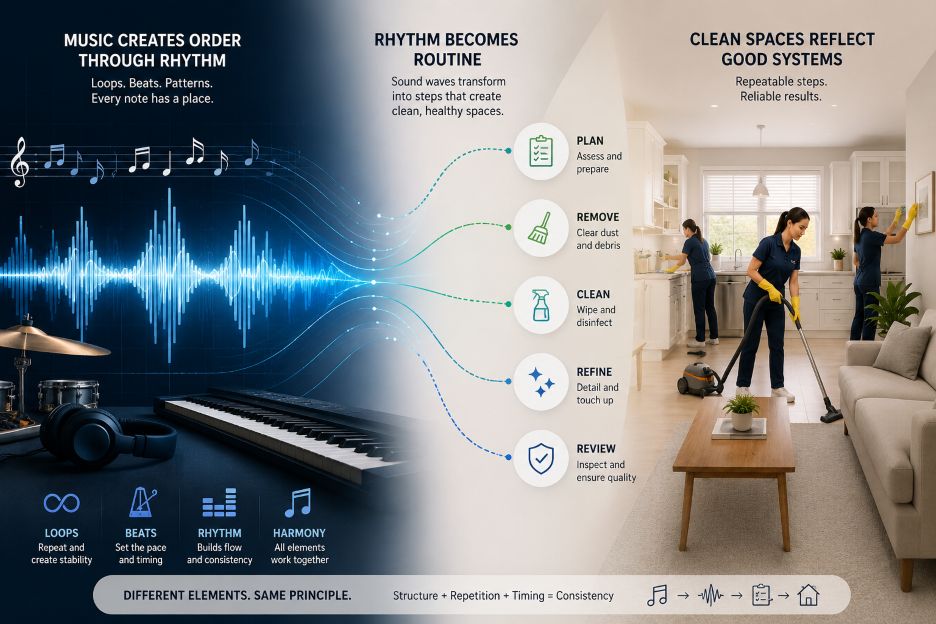

 Visual components such as logos, colors, and fashion are used by artists to identify their brand. Regular images make viewers identify them immediately. This establishes a powerful and catchy brand.
 Live streaming has emerged as a potent asset to musicians. Artists are able to stream and communicate with fans wherever they are. This increases their scope and has a personal touch.
 Instagram has changed how music is shared and discovered. Artists no longer depend only on record labels or radio exposure. A well managed Instagram account can introduce music to listeners worldwide. Growth comes from understanding how people consume content on the platform. Musicians who plan their posts carefully see better results over time. This article explains tips for growing Instagram followers (source: 인스타그램 팔로워 늘리기 팁) in the music industry. Each tip is easy to follow and realistic for independent artists.